

Go lateral
 Good surfing doesn’t always mean you have to dominate the wave.
I’m going to expand a little on the things I touched on in A quiver approach – if you’ve already read it you’ll know there is a common thread to my own choice of surfcraft. Personally I believe style is all important in surfing, I don’t care how radical your turns are, if you have an ugly style, I’m not interested.
Having been initially drawn to the style inherent in traditional longboarding, once I started to experiment with shorter boards I looked for shapes that would still allow a smooth flowing style, one that works with the wave, rather than trying to beat it into submission.
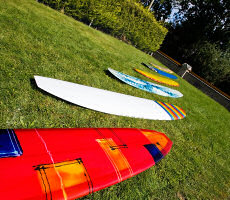
When I’m trying to explain it to others I often term it like this: conventional shortboarding is all based on getting vertical, drawing very “up & down” lines on the wave. The surfing I’m into is based very much on drawing more flowing lateral lines on the wave, heavy singlefin logs on small waves, two- and four-fin fish on bigger waves and, lately, the ultimate lateral trim machine – the displacement hull.
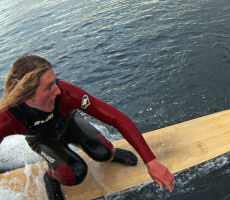
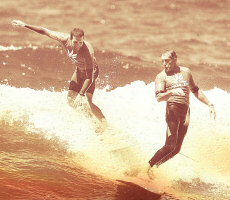
If you watch a decent amount of video of these designs you will notice that there is a consistency to the tracks they draw, even though the direction changes may get a little more radical as the length comes down. I think you can draw a line through history based on this observation, from the very earliest surfcraft through to these modern boards, whereas modern day shortboards represent the endpoint of a branch that sprouted following the “shortboard” revoloution of the late sixties when there was a global reaction against almost the principal of “trim” itself.
Some of you will relate to that, some of you will think it’s boring surfing. Thats cool. Each to their own – the world would be a boring place if we all liked the same thing. but I know I’m not the only one who feels this way.